DIY Solar-Powered Robot Car Kit – 4-Wheel STEM Project
Original price was: 150.00 EGP.132.00 EGPCurrent price is: 132.00 EGP.
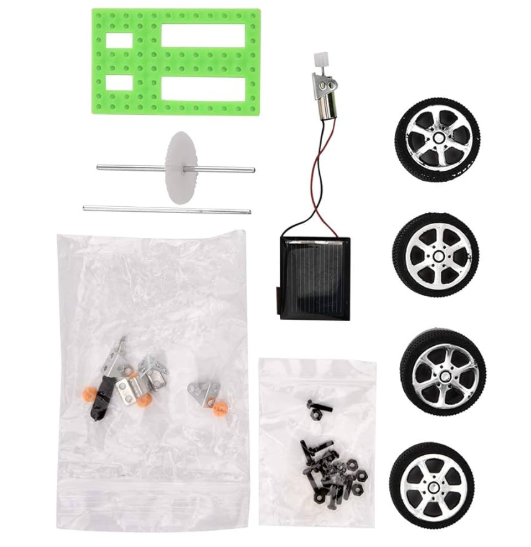
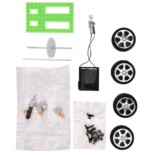
Build a moving Solar-Powered Robot Car and explore how sunlight can produce mechanical motion. This unassembled educational kit includes a solar panel, green plastic chassis, DC motor, gear mechanism, axles, and four wheels. It requires no batteries, programming, or microcontroller, making it ideal for STEM activities and renewable-energy demonstrations.
DIY Solar-Powered Robot Car Kit
The Solar-Powered Robot Car is an educational DIY kit that demonstrates how sunlight can be converted into electrical energy and then into mechanical motion. After assembly, the included solar panel supplies electricity directly to the small DC motor. The motor then transfers movement through the gear mechanism to drive the car.
This kit is suitable for students, young makers, hobbyists, and classroom science activities. It provides a simple introduction to solar energy, electric motors, mechanical transmission, wheel alignment, and basic vehicle construction.
No Arduino board, microcontroller, software, or programming is required.
Learn How Solar Energy Works
When sufficient light reaches the solar panel, the photovoltaic cells generate electrical power. This power operates the DC motor, while the motor and gear mechanism rotate the driven axle. As a result, the four-wheel car moves across a smooth surface.
The project allows students to observe the complete energy-conversion process:
Sunlight → Electrical Energy → Motor Rotation → Mechanical Movement
Because the solar panel powers the motor directly, vehicle speed depends on the intensity and angle of the available light. Therefore, the car performs best outdoors under strong, direct sunlight. Weak indoor lighting, cloudy weather, shadows, or an incorrect panel angle may cause slow movement or prevent the motor from starting.
Easy Educational Assembly
The Solar-Powered Robot Car arrives as an unassembled kit. Users install the axles, wheels, gears, motor, solar panel, and other mechanical parts onto the green plastic chassis.
The assembly process helps students develop practical skills such as following instructions, identifying mechanical components, aligning gears, checking wheel movement, and testing an electrical circuit. Moreover, the finished car provides immediate visual feedback when the solar panel receives enough light.
The kit normally requires mechanical assembly only. No soldering is required for the standard version. However, adult supervision is recommended for younger students because the package contains small components.
Key Features
- DIY solar-powered moving car kit
- Uses renewable solar energy
- Four-wheel vehicle design
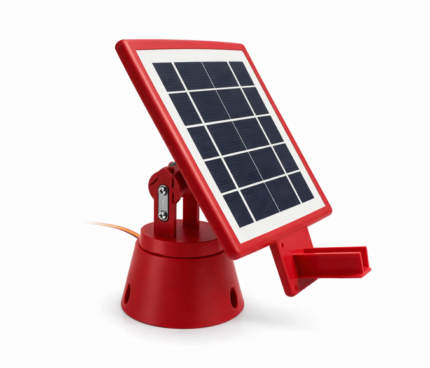
- Includes a miniature solar panel
- Small DC motor with gear-drive mechanism
- Lightweight green plastic chassis
- No batteries required
- No programming required
- No Arduino or microcontroller required
- Simple mechanical and electrical construction
- Suitable for science experiments and STEM education
- Helps explain energy conversion and motor operation
- Reusable for classroom demonstrations
Applications
This kit is ideal for school science projects, STEM workshops, renewable-energy demonstrations, home learning, electronics clubs, and beginner mechanical activities. It can also be used to compare car performance under different lighting conditions or solar-panel angles.
Students can investigate how shadows, surface friction, gear alignment, and wheel position affect the movement of the vehicle. Therefore, the kit offers more than simple assembly and can support several practical science experiments.
Important Operating Notes
Place the assembled car on a flat and smooth surface under strong sunlight. Make sure the gears move freely and the wheels do not rub against the chassis. In addition, aim the solar panel directly toward the light source for maximum output.
This is a basic educational solar vehicle rather than a programmable or remotely controlled robot. Performance varies according to light intensity and correct assembly.