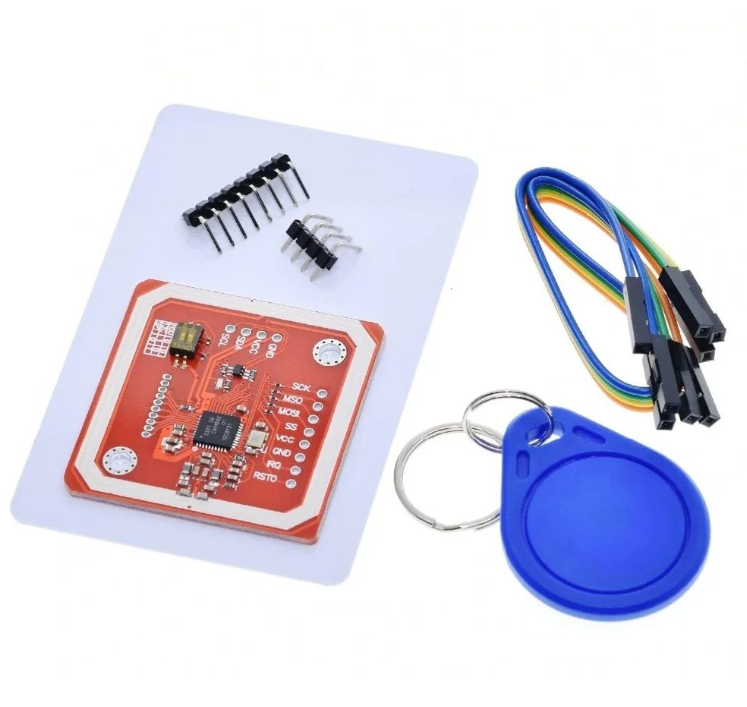
PN532 NFC/RFID Module 13.56MHz Read/Write – 43×41mm
Original price was: 250.00 EGP.245.00 EGPCurrent price is: 245.00 EGP.
The PN532 NFC RFID Read Write Module provides 13.56MHz contactless communication for Arduino, ESP32, STM32, and Raspberry Pi projects. It supports I2C, SPI, and HSU interfaces with an integrated PCB antenna and a compact 43×41mm design.
PN532 NFC RFID Read Write Module
The PN532 NFC RFID Read Write Module is a versatile 13.56MHz contactless communication board based on the NXP PN532 controller. It can read and write compatible NFC tags and RFID cards. Therefore, it is an excellent choice for access-control, identification, attendance, automation, and interactive electronics projects.
The module includes an integrated PCB antenna and supports three communication interfaces: I2C, SPI, and High-Speed UART. As a result, you can connect it to many popular development platforms, including Arduino, ESP32, STM32, and Raspberry Pi.
PN532 Module Features
- NXP PN532 NFC controller
- 13.56MHz operating frequency
- Reads and writes compatible NFC/RFID tags
- Supports ISO/IEC 14443A and MIFARE
- Supports FeliCa communication
- Supports ISO/IEC 14443B in Reader/Writer mode
- I2C communication interface
- SPI communication interface
- HSU High-Speed UART interface
- Reader/Writer operating mode
- Card-emulation capabilities
- NFC peer-to-peer communication
- Integrated PCB antenna
- Selectable interface mode
- Compact 43×41mm board size
- 3.3V to 5V module supply range
Common Applications
The PN532 NFC RFID Read Write Module can be used to build door-access systems, attendance machines, membership-card readers, payment prototypes, inventory systems, NFC-controlled equipment, smart locks, and interactive educational projects.
In addition, the module can read the UID and available data from supported tags. It can also write data to compatible writable cards and NFC tags when the selected library and tag permissions allow it.
Connecting the PN532 Module
Select the required interface using the switches on the module before connecting it to the controller. Then, connect the power and communication pins according to the selected I2C, SPI, or HSU mode.
The I2C and HSU interfaces share some connection pins. Therefore, always check the markings on the front and rear of the board. You should also restart the module after changing its communication mode.
Compatibility Information
Reading and writing capabilities depend on the card type, NFC tag, encryption, access keys, and software library. The module cannot freely modify every contactless card. Protected sectors on MIFARE cards require the correct authentication keys.
Communication distance also varies according to the tag size, antenna orientation, electrical noise, and installation conditions. For reliable operation, place the tag close and parallel to the onboard antenna.